


Cultural Fashion Series: The Cherokee Tear Dress
Fashion has the power to tell a story and allow individuals to express themselves. Not only can it educate about the past but also evolve over time. The stitchings and patterns on pieces of clothing are made with intentionality and can represent one’s culture. The Cherokee Tear dress is a wonderful example of this. This tear dress is “the official tribal dress for women of the Cherokee Nation of Oklahoma by proclamation of the National Council”.
Origins of the Cherokee Tear Dress
The very first tear dress was created in 1969 by Virginia Stroud. She won the title ‘Miss Indian America’ the previous year and wore a Kiowa buckskin dress she had borrowed from a friend. Chief Keeler and others “felt it was unacceptable for a Cherokee woman who was supposed to be representing the Cherokee people in the public eye to appear at public events dressed as a Kiowa”. This led to him appointing a committee of Cherokee women to seek out clothing that was deemed more appropriate for Stroud and the reflection of the Cherokee’s eastern woodland traditions, history, and style.
There is no one that is able to remember who named it the Tear Dress. Not to be mistaken or pronounced as in “the act of crying" or in "Trail of Tears", but as in “rip and tear”. The name takes on the figure of speech, onomatopoeia, describing how pieces of the Tear Dress are being cut in construction. The very first dress made and worn by Stroud was "constructed of simple shapes of squares and rectangles and each piece was torn across the grain of the fabric and not cut with scissors”. While its name origins are unknown, its significance still stands.
The Tear Dress is meaningful to the Cherokee Nation yet there are some who believe in a myth surrounding the story of this treasure: The Cherokee women wore this style of dress during the Trail of Tears which took place in 1838-1839. This misconception is debunked by the fact that the Cherokee “never had a traditional style of dress that was unique or unethically different from any other tribe in the hot and humid Southeastern United States” along with the fact that the style is completely wrong for the period.
Shortly after Stroud won her title in 1969, an outdoor drama was created about the Trail of Tears. Costume designers needed to create outfits for women and decided to choose the Tear Dress for inspiration since there were not any documents or photographs that could be copied about women's attire during the Trail of Tears. The women’s costumes were meant to be replicas of Stroud’s Tear Dress. Marion Hagerstrand who was involved in the drama, “credits the costumier for making the first pattern for the tear dress”. She also notes, “On the day the people in the costume shop began to work on building the costumes for the show, there were only two existing dresses: the original trunk dress and the one currently worn by Virginia Stroud”. Knowing this makes it more understandable as to why many believe that Tear Dresses were worn by Cherokee women long before it actually was created.

Construction & Design of the Cherokee Tear Dress
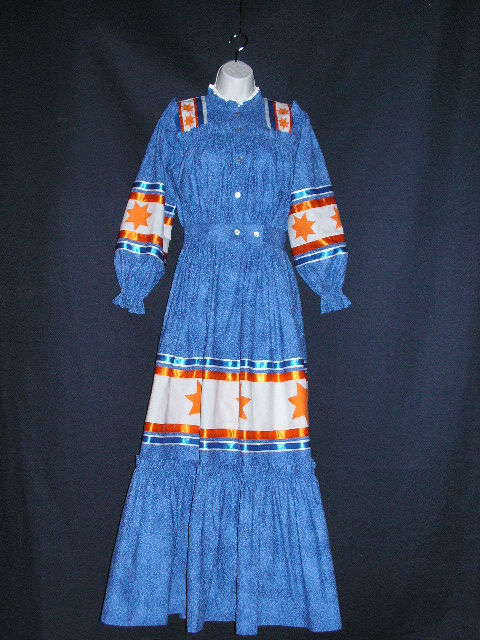
The sacredness of the Cherokee Tear Dress is something to be admired. When one is being designed and created, it is important that it is done with tender, care, and patience. It is no easy task, “making a Cherokee Tear Dress requires a medium-to-advanced knowledge of garment construction and sewing skills”. The measurements of the Tear Dress are meant to be “one-of-a kind” and meant to fit the individual wearing it. This particular Cherokee clothing was generally made at home by a family member or neighborhood seamstress. As mentioned before, all of the pieces of the dress must be made of squares and rectangles. Some other basic elements include, “The bodice must be gathered onto a shoulder yoke and open the front; There must be a stand up ruffle where the lower bodice and sleeve are attached to the yoke and where the skirt flounce is attached to the upper skirt panels; There must be decorative fabric bands at certain places on the dress, which are over each shoulder of the yoke, around each sleeve, and around the upper shirt just above the flounce”.
As these guidelines are being followed, women have the freedom to choose different variations of fabrics, skirt lengths, and decorative bands that reflect their own sense of style. This is meant to represent the Cherokee culture along with what makes the individual wearing the Tear Dress unique. This perspective and care of the creation of the Cherokee Tear Dress displays its importance now and how it has been able to evolve over time.

The Importance of the Cherokee Tear Dress Today
In preparation for this article, I was able to interview and gain perspective from Tonia Weavel, a Cherokee National Treasure. I asked her why she believed Tear Dresses are still important to Cherokee culture today. This was her response:
“In today’s world we look to identify ourselves by our dress and appearance especially in the world of indigenous people. Dress indicates tribal affiliation and many times clan and birth order. Cherokee men were always associated with the hunting jacket, one of the few Cherokee clothing items that specifically indicated Cherokee origins. The women did not have the same until the early 1970s when the tear dress made its debut. We have embraced the tear dress as a practical yet beautifully embellished garment that belongs only to Cherokee women”.
“Cherokees, historically and in contemporary times, have been able to adapt not just their position as a tribal nation but to adjust to the society around us. We have modified our dress to fit the times and the tear dress is a prime example of that adjustment. We, today, embrace the cotton utilitarian dress as the marker for Cherokee women. That’s why the tear dress is important to the culture today”.

Special Memory Involving the Cherokee Tear Dress
Every Tear Dress has a story. Not only for the individual who wears the dress itself but also the hands behind it. Tonia was kind enough to share one of her special memories involving a Cherokee Tear Dress:
“My best memory about a tear dress is the first one I made. My friend asked me to make a dress for her daughter, Callie Vann. She was about 4 or 5 years old. I said I’d never made one but I’d try. I had a tear dress made for me by Ruth England, a Cherokee National Treasure for dress making. I studied how she had sewn my dress and attempted to make Callie’s. I did finish the dress and she wore it. Twenty or so years later Callie called me to ask if I would alter her wedding dress. I knew I’d come full circle”.


Comments